Get In touch with us
Let us know if you have any questions by using the contact form below. We will get back to you as soon as possible. Please note our data privacy policy.
If you’ve spent any time maintaining a commercial property or even just trying to keep your home’s exterior looking sharp, you know the “metal struggle.” You buy a beautiful set of railings or high-end outdoor furniture, and within two years, the edges are rusting, the paint is bubbling, and the sun has bleached the color into a chalky mess.
In the United States, we deal with some of the most diverse and punishing weather on the planet. From the salt-heavy air of the Florida coast to the -20°F winters in Minnesota and the scorching 110°F heat in Arizona, metal takes a beating. Most people think that powder coating is a ‘one size fits all’ solution. But there is a massive difference between a standard decorative finish and a heavy-duty vinyl powder coating.
At Rusty Lions, we’ve spent years in the trenches of metal finishing. We’ve seen what fails and what lasts. If you want a surface that can thrive in a “high-impact” life, you need to understand why vinyl (a thermoplastic) is the undisputed heavyweight champion.
To understand why vinyl wins, you have to understand the chemistry, but let’s keep it simple. Most powder coatings you see on cheap retail items are “thermoset” powders. These are usually polyesters or epoxies. When they go into the oven, they undergo a chemical reaction that makes them hard and brittle. Think of it like baking a cake; once it's baked, you can't melt it back down.
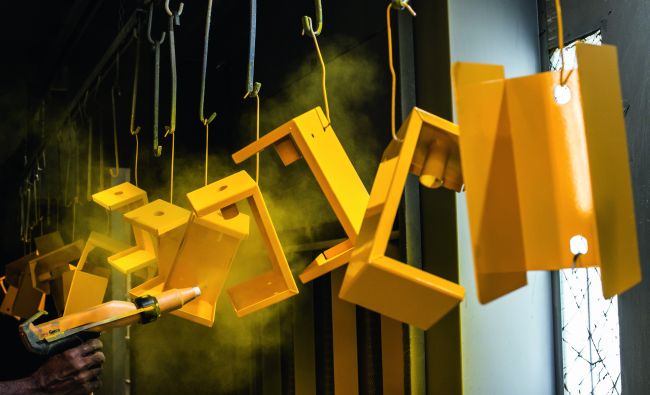
Vinyl powder coating is a thermoplastic. It’s more like a chocolate bar. We apply the powder to the metal, and it melts into a thick, uniform skin. As it cools, it becomes solid, but it retains a level of internal flexibility. It doesn’t set into a brittle shell. This flexibility is the single most important factor when you are dealing with impact-resistant coatings.
Because it’s a thermoplastic, it can be applied much thicker than standard powders. While a standard coat might be 2 or 3 millimeters thick (a millimeter or mil is 1/1000th of an inch), a vinyl coat is often 10, 15, or even 20 millimeters thick. That’s a massive physical barrier between your metal and the world.
Let’s talk about “impact”. In a warehouse, a city park, or a high-traffic restaurant, “impact” isn't a theory; it’s a daily occurrence. It’s a delivery driver hitting a bollard with a pallet jack. It’s a teenager dragging a heavy metal chain across a railing. It’s a lawnmower kicking up a stone at 60 miles per hour.
When a hard object hits a standard, brittle powder coating, the energy has nowhere to go. The coating shatters on a microscopic level. You might not even see the crack at first, but the seal is broken. Oxygen and moisture find that crack, get under the paint, and start eating the metal. This is called “undercutting” or “rust creep.”
Vinyl is different. Because it is flexible and thick, it acts as a shock absorber. When something hits it, the vinyl deforms slightly and then bounces back. It absorbs the energy of the blow rather than cracking under the pressure. This makes it the premier choice for outdoor metal furniture coating in public spaces where “gentle use” isn't in the vocabulary.
If you live anywhere near the ocean from the Jersey Shore down to the Gulf Coast, you know that salt is a metal killer. Salt air is highly corrosive, and standard thin-film coatings are often porous enough that salt ions can eventually migrate through to the metal.
Because vinyl is applied so thick, it creates a “tortuous path” for corrosion. It is virtually impossible for moisture or salt to work its way through 15 mils of solid vinyl. This is why you’ll see vinyl coatings on things like dishwasher racks, boat trailers, and marine-grade railings.
In the USA, we also use an incredible amount of road salt in the winter. If you have metal fencing or bollards near a road, they are being sprayed with a corrosive brine for three months out of the year. Standard paint won't survive that. Vinyl treats it like a light rain.
One thing people often overlook is how the metal feels. We’ve all had that experience of grabbing a metal handrail in the middle of a New York winter and having it feel like it's trying to fuse to your skin. Or, conversely, sitting on a metal park bench in the Texas sun and getting a literal burn.
Metal is an incredible conductor of heat and cold. Vinyl, however, is an insulator. A vinyl-coated surface has a much lower thermal conductivity. It stays touchable in extreme temperatures.
Furthermore, vinyl has a “soft-grip” texture. It’s not slippery like glass or hard polyester. This makes it a much safer choice for:
The American sun is brutal. If you’ve ever seen a red metal fence turn a weird, chalky pink, you’re looking at UV degradation. The sun’s rays break the chemical bonds in the paint, causing it to chalk. Not only does this look terrible, but that chalky residue gets on people's clothes.
Vinyl is naturally UV-stable. At Rusty Lions, we use high-grade vinyl powders that are engineered to sit in the sun for a decade without significant fading or chalking. It keeps that freshly finished look far longer than traditional paints.
Let’s be honest: nobody wants to spend their weekend or their maintenance budget repainting metal. In a commercial setting, the labor costs of repainting every two or three years are astronomical.
With vinyl powder coating, your maintenance routine is basically a garden hose. Because the surface is non-porous and smooth, dirt, bird droppings, and industrial grime don't “bond” to it. Most of the time, a good rainstorm does the cleaning for you. If you’re a property manager, this is the ultimate “set it and forget it” solution. You pay a bit more upfront for the quality, but you save thousands in labor and replacement costs over the life of the product.
You can’t just “slap on” a thermoplastic coating. It’s a technical process that requires a serious shop setup. This is where many of our competitors cut corners.
When you choose vinyl powder coating, you aren't just picking a color. You are choosing a protective engineering solution. You’re choosing to protect the structural integrity of your steel or aluminum.
Whether you are an architect designing a new public plaza, a business owner looking to refresh your storefront, or a homeowner who is tired of buying new patio chairs every three years, vinyl is the answer. It’s the “American-tough” finish that matches the reality of our environment.
At Rusty Lions, we don’t just do coatings, we solve problems. We’ve worked with everything from industrial parts to high-end custom furniture. We know the American landscape, and we know what it takes to make metal survive it.
If you’re ready to stop the cycle of rust and repainting, it’s time to go vinyl. Visit us at rustylions.com to see our gallery, learn more about our process, or request a quote for your next project. Let’s build something that lasts.
Vinyl powder coating is a high-performance thermoplastic finish known for its flexibility and durability. It creates a thick protective layer designed to withstand harsh environmental conditions and physical impact.
Unlike rigid coatings, vinyl is more flexible and rubber-like, allowing it to absorb impacts from rocks, debris, and heavy use without cracking or chipping.
Vinyl provides strong resistance to UV rays, moisture, and salt spray. It forms a waterproof barrier that helps prevent rust and corrosion in harsh outdoor environments.
Yes. Vinyl has low thermal conductivity, meaning it stays cooler in hot weather and warmer in cold conditions, making it ideal for frequently handled surfaces.
It is commonly used for outdoor furniture, playground equipment, marine components, and automotive parts due to its durability and resistance to environmental wear.
Vinyl is thicker and more flexible than polyester, offering better edge coverage and vibration resistance, making it more suitable for heavy-duty industrial protection.
Let us know if you have any questions by using the contact form below. We will get back to you as soon as possible. Please note our data privacy policy.
