Get In touch with us
Let us know if you have any questions by using the contact form below. We will get back to you as soon as possible. Please note our data privacy policy.
There is a specific kind of excitement that comes with finding a vintage piece of metal. Maybe it’s a classic motorcycle frame buried in a barn in Sussex County, a set of wrought iron patio chairs that have seen better days, or an industrial machine that needs a second life. You see the potential. But you also see the rust, layers of old, chipped paint—the grime of two or three decades.
You know you need to strip it down to the bare metal to do it right. You also know that taking a wire brush to it by hand will take you until the next millennium. That’s where sandblasting comes in. It is the “reset button” for metal restoration.
But here is the thing we’ve learned after 20 years in this industry: not all blasting is created equal. We have seen beautiful vintage car hoods warped by inexperienced operators using the wrong pressure. We’ve seen industrial parts rust in 24 hours because they weren't prepped immediately after blasting.
If you are looking for a professional sandblasting service, you need to know how to weed out the amateurs. Let’s walk through what you actually need to ask, what you should expect to pay, and how to make sure your project gets the treatment it deserves.
Before we dive into choosing a pro, let’s address the elephant in the room. You can buy a cheap blaster at a hardware store. We know a lot of guys who try this.
Here is the reality: Professional sandblasting isn't just pointing a nozzle and shooting sand. It’s about flow dynamics, media selection, and pressure regulation. When you hire a professional sandblasting service, you aren't paying for the sand; you are paying for the judgment of the operator. We know exactly how much pressure a cast-iron radiator can take versus a thin sheet metal fender.
A DIY rig usually lacks the power to remove deep rust efficiently, or worse, it creates a massive, dust-filled mess in your driveway that your neighbors in New Jersey will definitely complain about. Plus, there’s the health aspect; breathing in silica dust or old lead paint particles is a serious risk without the industrial-grade filtration systems we use in a dedicated shop.
When you call up a shop, whether it’s us here at Rusty Lions or someone else, you shouldn't just ask, “How much?” You need to dig a little deeper to protect your property. Here are the questions we’d ask if we were in your shoes.
This is the big one. The term “sandblasting” is actually a bit outdated. We rarely use actual sand anymore due to health risks (silicosis). A quality shop will use a variety of media depending on the job.
If the shop only has one answer (“We just blast it with grit”), that’s a red flag. They should match the media to your specific material.
You might be surprised how many “finishing shops” actually truck your parts out to a third-party industrial blaster, then truck them back to paint them. At Rusty Lions, we do our sandblasting in-house at our Franklin, NJ facility. Why does this matter? Because raw, blasted metal is incredibly vulnerable. If you blast a chassis and then put it on a truck in high humidity, it can start to flash rust before it even gets to the coating booth. Keeping the process under one roof ensures tight quality control and zero contamination.
Imagine getting your brake calipers blasted, only to find out the threads are stripped, or the piston bore is pitted because the operator didn’t mask them off. A professional knows that prep work is 80% of the job. Ask them how they mask off sensitive areas. They should be talking about high-temperature tape, silicone plugs, and custom masking, not just duct tape.
In the restoration business, we often joke that projects take “twice as long and cost twice as much.” But your sandblaster shouldn't hold your parts hostage for months. A professional shop should be able to give you a realistic window. Since we handle everything from the blast to the powder coat in one location, we can usually turn things around much faster than a shop that outsources.
This is the part everyone skips to, and we get it. You have a budget. But sandblasting cost and pricing can be tricky to pin down without seeing the part, which is why we always recommend bringing it in or sending photos.
Here is how a pro calculates the price:
The “Cheap” Warning: If you get a quote that seems too good to be true, ask yourself what they are skipping. Are they recycling dirty media that will contaminate your metal? Are they skipping the degreasing step? In this industry, fixing a bad blast job is way more expensive than doing it right the first time.
Living in the Northeast, specifically New Jersey, presents unique challenges for metal. We have high humidity in the summer and salt-crusted roads in the winter. This environment is brutal on metal.
When searching for a sandblasting service NJ residents trust, you need a team that understands local conditions. We see what the salt trucks do to undercarriages in Sussex and Passaic counties. We know that if we blast a rim in July, the humidity in the air means we have to get it into the curing oven for powder coating almost immediately.
Local knowledge also applies to logistics. If you are in Wayne, Paterson, or Franklin, you want a shop you can drive to. Shipping heavy metal parts across the country for restoration is cost-prohibitive. Having a local partner like Rusty Lions means you can shake our hands, see the facility, and discuss the project ‘face to face’. It also means that if you have a massive batch of industrial parts, we are close enough to handle the logistics smoothly.
If you’ve never used a professional blaster before, here is a quick rundown of what the process looks like when you come to our shop.
Sandblasting is rarely the final step. It’s the preparation. Once that metal is naked, it is racing against the clock to rust again. That is why at Rusty Lions, we specialize in the transition from blasting to Powder Coating.
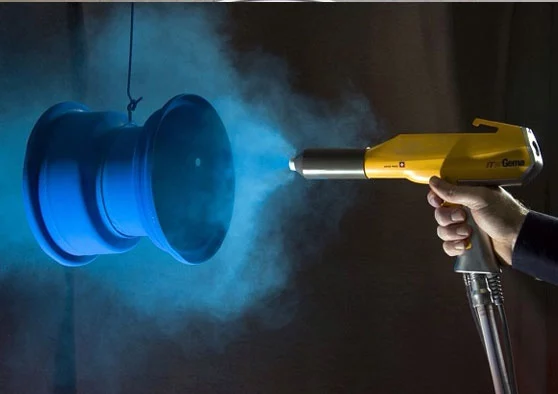
Because we handle both, we can ensure that the surface is perfectly prepped and chemically cleaned, and then immediately electrostatic-sprayed and cured. You don't have to worry about transporting raw metal or coordinating between two different vendors.
Restoring something, whether it’s a sentimental piece of patio furniture or a high-performance car part, is a labor of love. You are fighting entropy. You are refusing to let something go to the scrap heap.
Don’t let that effort go to waste by skimping on the foundation. Sandblasting is the foundation. If the prep is bad, the paint will fail. It is that simple.
So, ask the hard questions. Check the reviews. Visit us at Rusty Lions. We’ve been doing this for over 20 years because we love seeing that transformation just as much as you do.
Ready to get started? If you are in New Jersey and have a project that needs the professional touch, give us a shout. Let’s strip away the old and make it brand new again.
Let us know if you have any questions by using the contact form below. We will get back to you as soon as possible. Please note our data privacy policy.
